
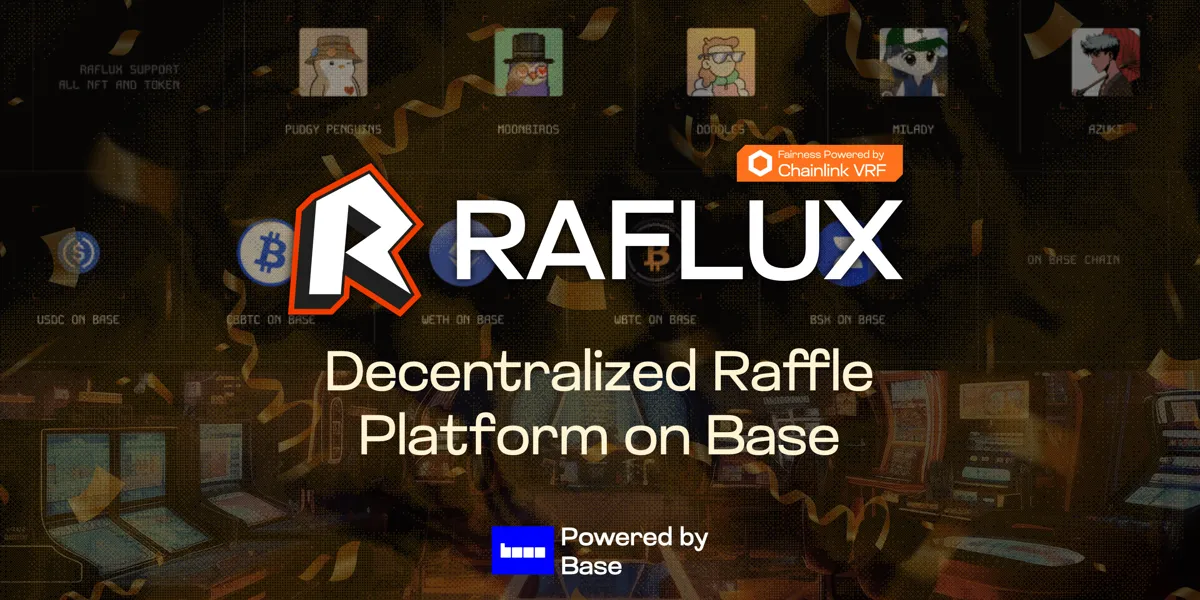
Raflux Complete Guide: How to Win NFTs Through Fair Blockchain Raffles
Listen, I’ve been around crypto long enough to see plenty of raffle platforms come and go. Most of them? You never really know if the draw was fair or if someone rigged the system. That’s exactly why Raflux caught my attention.
This isn’t another platform asking you to trust them. Raflux runs on Base blockchain with Chainlink’s random number generator, which means everything happens automatically through smart contracts. No human can mess with the results. Period.
In this guide, I’ll walk you through everything you need to know about Raflux. Whether you want to join raffles and win some NFTs, or you’re a creator looking to distribute your work, I’ve got you covered.
What Exactly is Raflux?
Raflux is a raffle platform built on Base (Coinbase’s layer 2 blockchain). Think of it as a lottery system, but completely transparent and fair.
Here’s what makes it different from traditional raffles:
Everything happens on blockchain. When you buy a ticket, it’s recorded publicly. When someone wins, you can verify it actually happened. No secrets, no backdoors.
Chainlink picks the winners. This is huge. Chainlink VRF (Verifiable Random Function) is the gold standard for random number generation in crypto. Major DeFi protocols trust it with millions of dollars. It’s mathematically impossible to predict or manipulate.
You actually own your tickets. Each ticket you buy becomes an NFT in your wallet. It’s yours. You can prove you entered, and no one can take that away from you.
Payments are in USDC. No need to worry about price swings during the raffle. USDC stays pegged to one dollar, so what you pay is what you pay.
The platform runs entirely on smart contracts. Once a raffle starts, even the creator can’t change the rules or stop it. The code is in control, not people.
Why Base Blockchain Makes Sense
You might wonder why Raflux chose Base instead of Ethereum mainnet or another chain. Good question.
Base is Coinbase’s layer 2 solution built on Ethereum. This means you get Ethereum’s security without the crazy gas fees. For context, a transaction that might cost you $20-50 on Ethereum often costs less than a dollar on Base.
This matters because you’re buying raffle tickets, sometimes multiple ones. Those fees add up fast. On Base, you can buy five tickets and pay pennies in fees instead of dollars.
Plus, Base has been growing fast. More users, more projects, more activity. Coinbase backing it gives people confidence, and that brings adoption.
How Raflux Actually Works
Let me break down the whole process from start to finish. I’ll explain it like I’m sitting next to you, because honestly, it’s pretty straightforward once you see it.
For People Joining Raffles
Step 1: You browse active raffles
Head to the Raflux platform and check out what’s available. You’ll see different NFTs, tokens, or other digital prizes up for grabs. Each raffle shows you:
- What you can win
- How much each ticket costs
- How many tickets are available
- How much time is left
- How many tickets have been sold already
This transparency helps you decide if the odds are worth it. If 1,000 tickets are available and only 50 are sold, your chances are better than if 900 are already taken.
Step 2: Connect your wallet
You’ll need a Web3 wallet like MetaMask, Coinbase Wallet, or Rainbow. If you’re new to this, MetaMask is probably your best bet. It works on Chrome, Firefox, and mobile.
Make sure you’ve added the Base network to your wallet. It takes about 30 seconds. Just search “add Base network to MetaMask” and follow the instructions.
Step 3: Get some USDC and ETH
You need USDC to buy tickets. You also need a tiny bit of ETH (on Base network) for transaction fees. We’re talking less than a dollar worth of ETH in most cases.
The easiest way? Use Coinbase or another exchange to buy USDC and ETH, then bridge them to Base. Coinbase makes this really simple since they built Base.
Step 4: Buy your tickets
Click the raffle you want to join. Choose how many tickets you want to buy. Approve the transaction in your wallet.
Within seconds, you’ll receive ERC-1155 NFT tickets in your wallet. These prove you entered. You can view them on OpenSea or any NFT platform that supports ERC-1155 tokens.
Step 5: Wait for the draw
This is the easy part. The smart contract counts down to the end time. You don’t need to do anything. You can close your browser, turn off your computer, whatever. The blockchain handles it.
Raflux has a Telegram bot that sends you updates. I recommend connecting it so you get notified when the raffle ends or if you win.
Step 6: Winners get paid automatically
When time runs out, the smart contract calls Chainlink VRF to generate a random number. That number determines the winner. Instantly, the prize gets sent to the winner’s wallet.
No waiting for someone to manually process it. No emailing support to claim your prize. It just shows up.
For Creators Running Raffles
Maybe you’re an NFT artist, a project founder, or someone with digital assets to distribute. Here’s how you’d use Raflux.
Step 1: Prepare your asset
Make sure the NFT or token you want to raffle is in your wallet. You’ll need to transfer it to Raflux’s smart contract, where it gets locked in escrow.
Think about what makes sense for your audience. High-value NFTs work well, but so do bundles of smaller items or governance tokens.
Step 2: Set your parameters
You get to decide:
- Ticket price – How much in USDC per ticket
- Total tickets – Maximum number available
- Duration – How long the raffle runs
- Minimum threshold – Minimum tickets that need to sell (optional)
These choices affect your results. Price tickets too high, and people might not buy. Make too many tickets available, and it might not sell out. You have to find the balance.
Step 3: Lock your asset and launch
Once you approve the transaction, your asset moves into the smart contract. At this point, you can’t take it back until the raffle concludes according to the rules.
This is actually a feature, not a bug. It proves to potential participants that you can’t rug pull them. The asset is genuinely available as a prize.
Step 4: Promote your raffle
Raflux doesn’t market your raffle for you. That’s on you. Share it on Twitter, Discord, Telegram, wherever your community hangs out.
The more excitement you build, the more tickets you’ll sell. Some creators offer sneak peeks, do countdown posts, or team up with other projects for cross-promotion.
Step 5: Collect your proceeds
When the raffle ends (assuming it met any minimum threshold you set), the USDC from ticket sales automatically transfers to your wallet. Minus the platform fee, of course.
The winner gets their prize at the same time. Everything happens in one transaction. Clean, simple, automatic.
The Chainlink VRF Advantage
I want to spend a minute on this because it’s really the heart of why Raflux works.
Traditional raffles have a trust problem. Someone has to pick the winner, and you have to trust they did it fairly. Even if they livestream the drawing, people question if it was staged.
Chainlink VRF solves this completely. Here’s how it works in simple terms:
When the raffle ends, the smart contract sends a request to Chainlink’s network of oracle nodes. These nodes generate a random number using cryptography. They send back both the random number and mathematical proof that it was generated fairly.
The smart contract verifies this proof before accepting the number. If the proof doesn’t check out, the contract rejects it and requests a new number.
Once verified, the contract uses that random number to pick a winner from all ticket holders.
The beautiful part? You can check all of this yourself on the blockchain. Every step is recorded publicly. The request, the response, the proof, the winner selection. It’s all there.
No one at Raflux can manipulate it. The creator can’t manipulate it. Chainlink can’t manipulate it without getting caught immediately. The system is trustless by design.
Understanding the Ticket System
Your raffle tickets aren’t just database entries. They’re actual NFTs following the ERC-1155 standard.
What does this mean for you?
Proof of ownership: You can prove you entered without relying on Raflux to show you. Your wallet shows your tickets.
Potential transferability: Depending on how the raffle is set up, you might be able to trade or sell your tickets. Not all raffles allow this, but the technology supports it.
Permanent record: Even after the raffle ends, you still have these NFTs. They become collectibles showing which raffles you participated in.
Transparency: Anyone can look at the smart contract and see exactly how many tickets exist, who owns them, and whether any special conditions apply.
This is way better than traditional raffle systems where you just get an email confirmation. Emails can be faked. NFTs in your wallet cannot.
Security and Safety
Let me be real with you about security because this matters.
Smart contract risks exist. Any blockchain platform involves smart contracts, and smart contracts can have bugs. Raflux has gotten their contracts audited, which is good. But audits aren’t perfect. There’s always some risk.
Wallet security is on you. If someone gets your private keys or seed phrase, they can steal everything in your wallet, including your raffle tickets and prizes. Use a hardware wallet for large amounts. Never share your seed phrase with anyone.
Verify everything yourself. Don’t just trust what the website says. Check the smart contract address on a blockchain explorer like BaseScan. Make sure it matches what Raflux officially publishes.
Start small. Your first time using Raflux? Don’t buy $1,000 worth of tickets. Buy one or two tickets to see how it works. Get comfortable with the process before going bigger.
Watch out for scams. Fake Raflux sites will definitely pop up trying to steal your funds. Always double-check you’re on the real website. Look for the official links in Raflux’s documentation or social media.
The good news is that once you understand these basics, using Raflux is actually quite safe. The smart contracts handle everything automatically, so there’s no human error in prize distribution or winner selection.
Real Use Cases That Make Sense
Let me give you some practical examples of how people are actually using platforms like Raflux.
NFT artists building hype: Instead of selling an NFT for $5,000 and only reaching one buyer, an artist can raffle it off at $50 per ticket. Sell 100 tickets, make $5,000, but now 100 people engaged with your work instead of just one. Those 99 people who didn’t win? They’re still part of your community now.
Gaming projects distributing items: Web3 games can use raffles to distribute rare in-game items. It’s more exciting than a random drop and more fair than first-come-first-served.
DAOs rewarding community members: Decentralized organizations can run raffles as loyalty rewards. Participated in governance? Get free raffle tickets for exclusive NFTs or tokens.
New projects building communities: Instead of an expensive airdrop to everyone, projects can run raffles that reward the most engaged community members. Better targeting, more excitement.
Fundraising with accountability: Someone wants to raise money for a project or cause. They can raffle valuable NFTs with all proceeds going to the stated purpose. The blockchain proves where the money goes.
The key is that raffles add an element of excitement and fairness that straight sales or random airdrops don’t provide.
Costs You Should Know About
Let’s talk money. No surprises here.
Ticket prices: Set by the raffle creator. Could be $1, could be $100. You decide if the odds are worth the price.
Gas fees: You pay network fees for transactions. On Base, these are usually under $1. Budget a few dollars worth of ETH to be safe.
Platform fee: Raflux takes a small percentage of raffle proceeds. This covers their operations and future development. The exact percentage should be clearly stated on their platform.
No hidden charges: That’s it. Those three things. No surprise fees when you win, no withdrawal fees, nothing else.
Compare this to traditional raffle platforms that might take 10-20% in fees, charge credit card processing fees, and make you wait days for payment.
Common Questions People Ask
Do I need to be a crypto expert to use this?
No, but you do need basic knowledge. You should understand how to use a Web3 wallet, how to buy USDC, and how to approve transactions. If you’ve ever used MetaMask or bought anything on a DEX, you’re ready.
What if the raffle doesn’t sell enough tickets?
Some raffles set a minimum threshold. If it’s not hit, the raffle cancels and everyone gets refunded automatically through the smart contract. Always check if a minimum exists before buying tickets.
Can the creator cancel a raffle after I buy tickets?
No. Once the raffle launches, the smart contract controls it. The creator can’t cancel it, change the rules, or withdraw the prize. The only way it doesn’t happen is if it doesn’t meet a preset minimum threshold.
How do I know if I won?
You’ll see the prize NFT or tokens appear in your wallet. If you connected the Telegram bot, you’ll get a notification. You can also check the raffle page to see the winner’s address.
Can I trust Chainlink VRF?
Chainlink VRF is used by major DeFi protocols handling hundreds of millions of dollars. It’s been audited extensively. In crypto, it’s about as trustworthy as random number generation gets. Nothing is 100% perfect, but this is the industry standard for a reason.
What happens if I lose access to my wallet?
You lose everything in it, including raffle tickets and prizes. This is crypto, not a traditional service with password reset. Write down your seed phrase and keep it somewhere safe. Consider using a hardware wallet for valuable assets.
Are there geographic restrictions?
The blockchain doesn’t care where you live. However, you’re responsible for following your local laws about online raffles and cryptocurrency. Some jurisdictions have restrictions on gambling or raffles. Do your research.
Tips for Better Results
After watching how people use these platforms, I’ve noticed some patterns that lead to better outcomes.
For participants:
Do the math on your odds. If a $100 NFT has 10 tickets at $5 each, you’re essentially getting 2:1 odds on a $50 bet. That’s decent. If it has 1,000 tickets at $5 each, you’re betting $5,000 collective dollars for a $100 prize. Those odds are terrible.
Join raffles early. Sometimes creators offer bonuses for early participants. Plus, you know the raffle will actually happen if you’re in early.
Spread your bets. Instead of buying 10 tickets in one raffle, consider buying 2 tickets each in five different raffles. More chances to win something.
For creators:
Price competitively. Research what similar raffles charge and what their sell-through rates are. Don’t get greedy.
Build hype before launching. Don’t just post the raffle link and hope. Tease it, countdown to it, make it an event.
Set realistic ticket amounts. Better to have 50 tickets sell out in an hour than 500 tickets sell slowly over a week. Sellouts create FOMO.
Engage with participants. Answer questions, share updates, make people feel involved. Your raffle is a community event, not just a transaction.
The Bigger Picture
Raflux is part of a larger shift in how we think about digital ownership and distribution.
Traditional platforms control everything. They can ban you, freeze your assets, change the rules whenever they want. You have to trust them completely.
Blockchain platforms like Raflux flip this model. The rules are in code that nobody can change. Your tickets are NFTs that nobody can take away. The prize distribution happens automatically whether Raflux exists or not.
This matters beyond just raffles. It’s a template for how many services could work. Gaming achievements, loyalty programs, event tickets, membership access. All of these could run on similar trustless systems.
We’re early in this transition. Raflux and platforms like it are experiments in new ways of organizing digital interactions. Some will succeed, some will fail, but the general direction seems clear.
People want transparency. They want provable fairness. They want to own their digital assets. Blockchain enables all of this.
Getting Started Today
Ready to try Raflux? Here’s your action plan.
Step 1: Set up MetaMask or Coinbase Wallet if you haven’t already. This takes about five minutes.
Step 2: Add the Base network to your wallet. Follow the instructions on Base’s official website.
Step 3: Buy some USDC and ETH on Coinbase or another exchange. Bridge them to Base network.
Step 4: Visit the official Raflux website. Double-check the URL against their documentation.
Step 5: Browse active raffles. Look for something with reasonable odds and a prize you actually want.
Step 6: Buy one or two tickets to start. Get familiar with how it works.
Step 7: Connect the Telegram bot for updates.
Step 8: Learn from the experience. Whether you win or lose, you’ll understand the platform better.
Start small, learn the ropes, then scale up if it makes sense for you.
Final Thoughts
Raflux isn’t going to make you rich overnight. It’s not some magical money printer. It’s a tool.
For creators, it’s a way to distribute assets fairly while building community engagement. For participants, it’s a shot at winning something cool with transparent odds.
The real innovation here isn’t the raffle concept itself. Raffles have existed forever. The innovation is making them completely transparent, provably fair, and automated through smart contracts.
No more wondering if the draw was rigged. No more trusting some company to act honestly. The code handles everything, and you can verify it yourself.
Is it perfect? No. Smart contracts can have bugs. Gas fees add up. The user experience still isn’t as smooth as Web2 platforms. But it’s getting better.
If you’re interested in NFTs, blockchain gaming, or just want to understand how DeFi applications work in practice, Raflux is worth exploring. It’s a real working example of blockchain technology solving actual problems.
Just remember to start small, do your own research, and never invest more than you can afford to lose. This is crypto, after all. Nothing is guaranteed except volatility and adventure.
Good luck, and may the blockchain odds be ever in your favor.