

Salam Ever bought into a crypto project early, only to watch the price crash within hours? You’re not alone. Most token launches follow the same painful pattern: early investors dump their tokens, prices tank, and loyal supporters get left holding the bag.
AlignerZ is changing this completely.
Founded by Roger Francis in 2025, this Delaware-based platform introduces a fresh approach to crypto fundraising. Instead of rewarding quick flippers, it actually benefits people who stick around. Sounds too good to be true? Let me break down exactly how it works.
Why Most Token Launches Fail (And How AlignerZ Fixes This)
The Dumping Problem
Here’s what typically happens with new token launches:
You invest early because you believe in the project. The token goes live. Within minutes, early investors start selling. The price drops fast. Panic spreads. Even believers start selling to cut losses. The project dies before it can build anything meaningful.
This happens because of one simple rule: whoever sells first makes the most profit. Everyone knows this, so nobody trusts anyone else to hold. The result? A race to the bottom that destroys promising projects.
What Founders Really Need
Think about it from a founder’s perspective. Building a successful crypto project takes time. You need to:
- Develop the product
- Form partnerships
- Listen to user feedback
- Make improvements
- Find your market fit
But if your token price crashes immediately after launch, you’ll struggle to do any of this. Your community loses faith. Good team members leave. Potential partners back away.
No serious founder wants to raise money from people who’ll dump on their loyal community. Yet that’s exactly what traditional launches attract.
How AlignerZ Actually Works
The Big Idea: Longest Holders Win
AlignerZ flips everything around. Their system is called Initial Weight Offering, or IWO for short. Here’s the core concept:
The longer you commit to holding, the better deal you get.
Not first come, first served. Not biggest whale wins. Simply: commit longer, get rewarded more.
The Bidding Process Explained
Let’s walk through how you’d participate in an AlignerZ token launch:
Step 1: You Place Your Bid
You decide how much money you want to invest and how long you’re willing to lock up your tokens. Maybe you choose a 12-month vesting period. Maybe 24 months. Your choice.
Step 2: See Where You Stand
The platform shows you real-time results. You can see how your bid compares to others based on vesting length. Not happy with your position? You can increase your investment or extend your vesting time.
Step 3: Allocation Happens
When bidding closes, the platform awards tokens starting with the longest vesting commitments. Someone who chose 36 months gets served before someone who chose 12 months, even if they bid later.
Step 4: Get Your Tokens or Refund
If you secured an allocation, great! If the pool ran out before reaching your bid, you get your full money back (minus gas fees).
The Anti-Gaming System
Smart people might think: “I’ll just wait until the last second and bid slightly longer than everyone else.”
AlignerZ thought of this. They use something called a hashed bidding window. Basically, the bidding period has a hidden end time. It could end in 30 minutes or 5 hours. Nobody knows, not even insiders. When it ends, they reveal how they calculated the time, and everyone can verify it was fair.
This removes any advantage for last-minute snipers or people with inside information.
The Breakthrough: Tokenized Value Sequencers (TVS)
The Liquidity Problem Solved
Now you might be thinking: “Sounds good, but I don’t want my money locked up for years. What if I need cash?”
This is where AlignerZ gets really clever. They created something called Tokenized Value Sequencers, or TVS for short.
Think of a TVS as a special NFT that represents your locked tokens. Even though your actual tokens are vesting, you can sell this NFT anytime you want.
Real-World Example
Let’s say you won an allocation with a 24-month vesting schedule. You now hold 10,000 tokens that unlock gradually over two years. But six months in, you need money for an emergency.
With traditional vesting, you’re stuck. With AlignerZ, you simply sell your TVS on an NFT marketplace. Someone else buys it (usually at a discount to the token value) and receives your future token flow.
You get liquid cash. They get discounted tokens. Everyone wins.
Splitting and Merging
The flexibility gets even better. You can split one TVS into multiple smaller ones or merge several into one large position.
Example scenario: You hold a TVS worth $100,000. You need $10,000 for something urgent. Instead of selling everything, you split off a $10,000 portion and sell just that piece. You keep the remaining $90,000 TVS and continue receiving most of your token flow.
The math stays fair too. If your original TVS was paying out 100 tokens per month, after a 10% split, you’d get 90 tokens monthly and the buyer gets 10 tokens monthly (minus a tiny 0.5% splitting fee).
Why TVS Trading Makes Sense
TVS typically trade at a discount to token value. This creates interesting opportunities:
For sellers: Get immediate liquidity without waiting for vesting to complete.
For buyers: Purchase tokens at below market price by taking on the vesting period.
For the project: Reduce selling pressure on the actual token since people can exit through TVS sales instead.
When a TVS is listed below fair value, buyers naturally compete to grab the discount, pushing the price back up. Market forces keep everything balanced.
Meet $A26Z: The Platform Token
Token Basics
Total supply: 26,000,000 tokens (that’s it, no more will ever exist)
The token lives on multiple networks including Polygon, Arbitrum, and Base, with more coming soon. The team is still deciding which network to launch on first.
Where The Tokens Go
Here’s the breakdown of all 26 million tokens:
59.23% goes to the Initial Weight Offering – that’s regular people like you participating in the launch
19.61% goes to company reserves, locked for 26 years (yes, twenty-six years)
11.5% goes to the founding team, also locked for 26 years
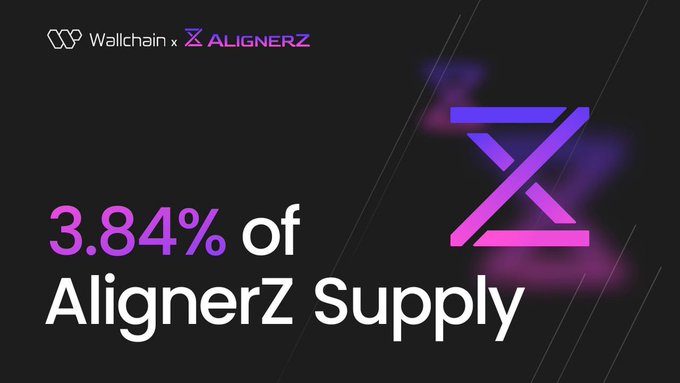
3.84% provides initial liquidity for trading
3.84% allocated to WallChain epoch 1
1.92% sold in private sales
Notice something? The team and company tokens are locked for 26 years. That’s not a typo. This shows extreme commitment to long-term thinking.
The Buyback and Burn System
Every three months, AlignerZ takes 15% of its profits and uses that money to buy $A26Z tokens from the market and destroy them permanently.
This happens automatically until the token hits $100. Think about what this means: as the platform grows and makes more money, more tokens get removed from circulation. Basic supply and demand suggests this should push prices higher over time.
Vesting Rewards: Getting Paid to Hold
Here’s something cool. AlignerZ gives 5% of quarterly profits directly to TVS holders. The bigger your TVS and the longer your vesting period, the more you receive.
But there’s a twist. Instead of paying out rewards all at once (which would create gaming opportunities), they drip the rewards to you continuously, every single second.
Why this matters: Imagine rewards were paid once per quarter. Someone could buy a TVS right before payout, collect the reward, then immediately sell. They’d benefit the same as someone who held for months. Not fair, right?
By dripping rewards constantly, only people who actually hold over time get the full benefit. Quick flippers get almost nothing.
Real numbers example:
Three people hold TVS tokens. The quarterly reward pool is $1,000,000.
Person A: 10,000 tokens locked, 10 months remaining Person B: 1,000 tokens locked, 10 months remaining
Person C: 10,000 tokens locked, 3 months remaining
In month one, Person A gets about $543,000 in rewards. Person C, despite having the same amount locked, only gets about $402,000 because their vesting ends sooner. As months pass and tokens unlock, the rewards shift. By month three, Person C gets nothing (their vesting finished) while Person A continues earning.
The system constantly rewards those with the most at stake.
The IWO Pricing: Better Deals for Patient Money
Five Pools, Five Prices
When $A26Z launches, tokens will be available across five different pools. Each pool has a different price, and remember: the people who commit to longest vesting get first pick.
- Pool 1: 2.2 million tokens at $0.10 each
- Pool 2: 3.3 million tokens at $0.18 each
- Pool 3: 4.4 million tokens at $0.23 each
- Pool 4: 5 million tokens at $0.28 each
- Pool 5: 500,000 tokens at $0.33 each
The token will list on exchanges at $0.50. Look at those discounts:
- Pool 1 = 80% discount (plus you get your money back!)
- Pool 2 = 64% discount
- Pool 3 = 54% discount
- Pool 4 = 44% discount
- Pool 5 = 34% discount (plus you get your money back!)
Yes, Pool 1 and Pool 5 winners receive bonus refunds. You keep the tokens AND get your USDT back. Essentially free tokens if you commit to the longest vesting.
How Allocation Works
Bidding starts and the pools fill based on vesting commitment length. Let’s say Pool 1 fills up entirely with people committing to 36+ month vesting. Then Pool 2 starts filling with slightly shorter commitments, and so on.
If you bid for tokens but all pools fill before reaching your bid, you don’t get tokens but you do get your full money back.
The CEO’s Skin in the Game
Here’s something you don’t see often. Roger Francis, the CEO, tied his own salary directly to the token’s performance.
His monthly pay is calculated like this: $1,000 base plus 5,000 times the average of the lowest daily prices that month.
Let me put that in perspective:
If the token trades between $0.50 and $1.00 all month, with the lowest daily prices averaging $0.50, Roger makes: $1,000 + (5,000 × $0.50) = $3,500 for the month.
If the average low is $2.00, he makes $11,000. If the average low is $10.00, he makes $51,000.
His interests are completely aligned with yours. If the token struggles, he barely gets paid. If it succeeds, he does well. Simple as that.
How AlignerZ Makes Money
Launch Fees
When projects launch on AlignerZ:
- 4% commission on total money raised
- 1% of the project’s tokens, vested for one year
These fees might change over time based on market conditions.
TVS Fees
- Splitting a TVS costs 0.5% (taken from your unvested tokens)
- Merging TVS is completely free
- Special campaign payouts cost 0.5%
These small fees keep the lights on and fund continued development. Nothing excessive, just enough to sustain operations.
What Happens With the Money
The funds raised through the IWO will be spent like this:
26% – Software development and upgrades 26% – Company reserves for long-term stability
16.6% – Liquidity for smooth trading 16.6% – Team bonuses and incentives 14.8% – Marketing and growth
Over half the budget goes directly into building and improving the product. That’s where focus should be.
The People Behind AlignerZ
Core Leadership
Roger Francis started this whole thing. He’s got a math background and spent years consulting for Web3 projects. Known for being detail-oriented and doing deep research before making decisions.
Andrew Gavrilov brings 13 years of design and development experience. He previously founded Undercat.io and built an education platform called WAYUP that trained over half a million people. His company worked with more than 100 startups.
Joseph Abou Rizk serves as Deputy CTO. He’s a security specialist who’s spent years auditing blockchain protocols and protecting user funds at companies like Nethermind and Hashlock.
Technical Team
Youssef Salameh handles backend development. Seven years building financial technology and blockchain systems. He’s led teams creating decentralized platforms and knows how to build things that scale.
Arkadiy Kovtun manages the frontend. His job is making sure complicated blockchain stuff feels simple and intuitive when you use it.
Sanemi covers cybersecurity with over 11 years in IT security. He focuses on keeping the platform secure and building a security-first culture across the organization.
Marketing Team
Cyber Warrior leads marketing efforts. Experienced in blockchain marketing and community building with a track record of growing brands through data-driven strategies.
Dave Choukroun serves as Chief Multimedia Officer. He’s hosted over 700 Twitter Spaces on crypto topics and knows how to engage communities through audio and visual content.
Why This Matters for Crypto
For Project Founders
Imagine launching your token without immediate price crash. Imagine your community staying excited instead of angry. Imagine having actual time to build your product and find market fit.
That’s what AlignerZ offers founders. Protection from speculation, time to execute, and a community that’s actually aligned with long-term success.
For Investors
Tired of buying early only to get dumped on? Tired of watching insiders exit while you hold? Tired of projects that promise long-term value but optimize for short-term pumps?
AlignerZ rewards you for the behavior that actually makes projects successful: patient capital and long-term thinking.
For the Industry
If AlignerZ succeeds, it proves something important: sustainable models can work in crypto. You don’t need to create pump-and-dump mechanics. You don’t need to sacrifice retail investors to enrich early insiders.
You can build something where everyone’s interests actually align. Where good projects get the runway they need. Where supporters get rewarded for support instead of punished for loyalty.
Getting Started
The exact launch date for the $A26Z IWO will be announced on AlignerZ’s official Twitter/X account. That’s where you’ll find the latest updates and instructions for participating.
The liquidity will be locked in automated market makers, meaning it can’t be pulled out. You’ll be able to trade from day one, but the deep discount pools only go to people who commit through the IWO process.
What Makes AlignerZ Different
Let’s be real for a second. Crypto is full of projects claiming to be revolutionary. Most aren’t. So what makes AlignerZ actually different?
It’s the incentives. Everything flows from getting the incentives right. Traditional launches incentivize dumping. AlignerZ incentivizes holding. That one change ripples through everything else.
It’s the innovation. TVS tokens are genuinely new. They solve the fundamental tension between wanting long vesting (good for projects) and wanting liquidity (good for investors). Both sides get what they need.
It’s the commitment. A 26-year vesting schedule for the team isn’t normal. A CEO salary tied to floor price isn’t normal. Refunding winners of the best pools isn’t normal. These signal serious long-term thinking.
It’s the problem being solved. This isn’t a solution looking for a problem. Every single person who’s participated in crypto launches knows the pain of early dumping. AlignerZ directly addresses the industry’s most obvious failure point.
Questions You Might Have
Isn’t long vesting just locking up my money?
Not with TVS. You can sell your vesting schedule anytime. You’re not actually locked up in the traditional sense. You have the option to stay vested and earn rewards, or exit whenever you want by selling your TVS.
How do I know the team won’t just dump their tokens?
They literally can’t. Their tokens are locked for 26 years with vesting. Even if they wanted to dump, the tokens aren’t available.
What if I need to sell my TVS but nobody wants to buy it?
If your TVS is priced reasonably (at a discount to token value), buyers will naturally appear because they can get tokens cheaper than market price. It’s an arbitrage opportunity.
Isn’t this complicated?
The underlying mechanics are sophisticated, but using the platform is straightforward. You bid, you get allocated (or refunded), you hold or sell your TVS. The team built complexity into the backend so the frontend could be simple.
Conclusion
Traditional token launches are broken. They reward the wrong behavior, hurt loyal supporters, and destroy projects before they can succeed. Everyone knows this but people kept using the same model because there wasn’t a better alternative.
Now there is.
AlignerZ isn’t perfect. No system is. But it’s addressing real problems with innovative solutions. It’s aligning incentives properly. It’s giving founders breathing room and rewarding patient capital. Most importantly, it’s showing the crypto industry that better models are possible. That you can raise money without creating exit liquidity traps. That long-term thinking can be systematically encouraged. Will it work? Time will tell. But the logic is sound, the team seems capable, and the problem being solved is painfully real.